The Agentic AI Manifesto: Beyond the Prompt
From Passive Intelligence to Active Agency
Most AI today is reactive—it waits for a human prompt to generate a single response. At OptimumT, we build Agentic AI: systems that don’t just “chat,” but “do.”
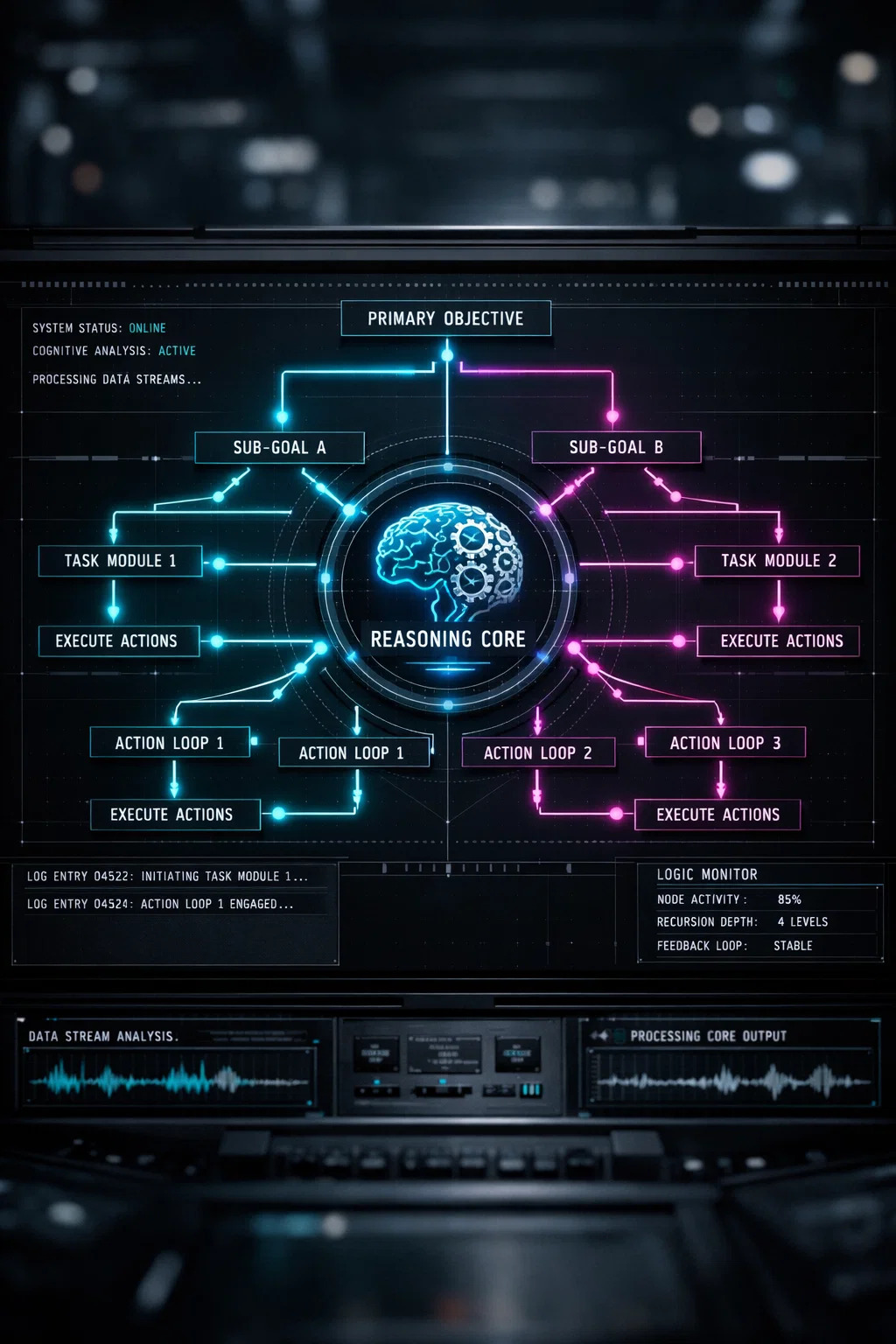
An agentic system is a reasoning engine that perceives its environment, decomposes a complex objective into a plan, and executes that plan through a continuous, self-correcting loop.
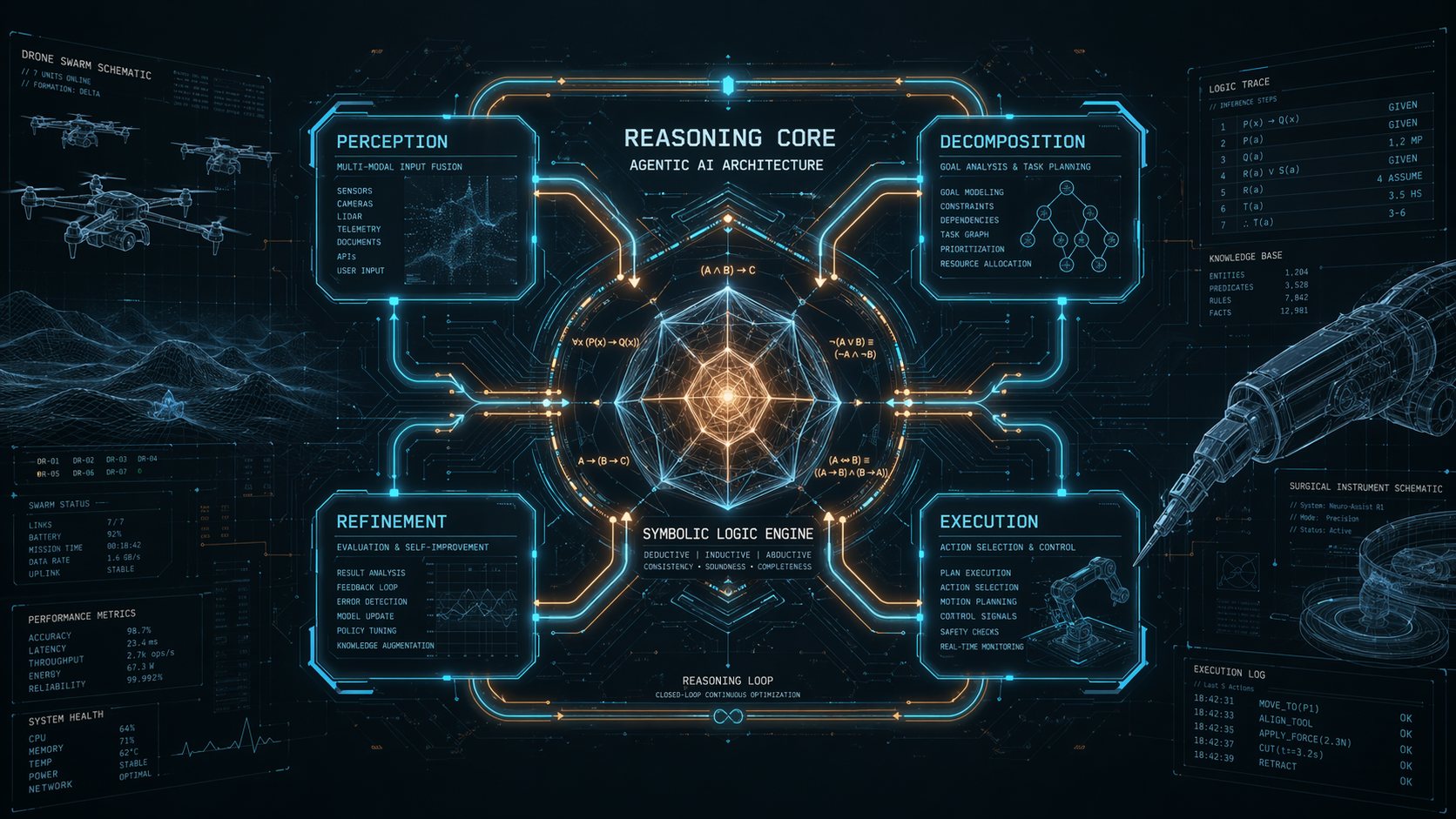
Our “Reasoning Core” Architecture
We replace probabilistic “guessing” with a structured loop designed for high-stakes environments.
1. Perception
Synthesizing the World Model Integrating multi-modal data—Vision, LiDAR, and high-frequency sensor telemetry—to create a real-time understanding of the operational environment.
2. Decomposition
Strategic Planning The agent breaks down a high-level objective (e.g., “Inspect the swarm’s perimeter”) into a sequence of verifiable, atomic tasks.
3. Execution
The Action Phase The system interfaces with hardware or software to perform the task. Unlike standard automation, the agent monitors the result of its action in real-time.
4. Refinement
The Self-Correction Loop If the environment shifts or a task fails, the agent re-plans instantly. This “Closed-Loop” feedback is what makes the system truly autonomous.
Why It Matters for Critical Infrastructure
The “Autonomy Gap” is the difference between an AI that suggests a solution and one that safely achieves it. We bridge this gap using Symbolic Logic Synthesis—ensuring every autonomous decision is checked against mathematically proven safety constraints.
-
Determinism: We move away from “black-box” AI. Our agents operate within a transparent logic framework.
-
Safety-First: In medical and industrial settings, the agent cannot “hallucinate.” Every path must be verified before execution.
-
Scalability: From a single surgical robot to a coordinated drone swarm, our agentic architecture scales to handle multi-agent complexity.
Core Application Pillars
| Sector | Agentic Value Proposition |
| UAV Swarms | Collective mission planning with dynamic collision avoidance. |
| Medical Devices | Procedural foresight that anticipates surgical complications in real-time. |
| Industrial Robotics | Adaptive manipulation in non-standardized manufacturing environments. |
The Capability Maturity Model
| Capability | Standard Automation (Level 2) | OptimumT Agentic AI (Level 5) |
| Decision Logic | “If-This-Then-That” (Static scripts) | Autonomous Goal Decomposition |
| Environmental Adaptation | Fails or stops when obstacles appear | Dynamic real-time re-planning |
| Error Handling | Human intervention required for recovery | Self-correcting reflection loop |
| Data Processing | Single-stream sensor triggers | Multi-modal world model synthesis |
| Mission Objective | Executes a fixed, repetitive path | Strives to achieve the mission intent |